Paper Empires
Paper Empires: financial crime documentaries from court records. Fraud, forged books and corporate collapse, told from the filings and the verdicts.
Paper Empires tells the stories of fortunes that existed only on paper.
Every episode follows one collapse from the inside: the arrangement that looked ordinary, the people who signed off on it, the moment the arithmetic stopped working, and what was left when the money was gone.
Researched from court records, regulatory findings and contemporary reporting. Sources are listed in every description.
New documentary every week.
Episodes
- Episode 5 · 29:56
The Father and Son Who Paid for Stock With Their Company's Own Debt
A financial crime documentary about Adelphia Communications, the cable company run from Coudersport, Pennsylvania. On 27 March 2002, in a footnote on the final page of a press release, Adelphia first disclosed approximately $2.2 billion in liabilities not previously reported on its balance sheet: bank loans it had taken out together with private companies owned by the Rigas family. The government did not contend there was "anything inherently wrong or unlawful" with the co-borrowing. The fraudulent conduct, the appeals court said, was the failure to properly disclose. In 2004 a jury convicted the founder, John Rigas, and his son Timothy, the chief financial officer, of conspiracy, securities fraud and bank fraud. In 2007 the Second Circuit reversed one bank fraud count and upheld the rest, and in 2008 they were resentenced to 12 and 17 years. Told from the court record: the Second Circuit's two opinions, the Justice Department's releases and the SEC's complaint and settlement.
- Episode 4 · 34:34
He Booked $18 Million of Sales of Drugs That Never Existed
A financial crime documentary about McKesson & Robbins, the drug company whose president, F. Donald Coster, was identified by his fingerprints in December 1938 as Philip M. Musica, who under that name had been convicted of commercial frauds. At the end of 1937 its certified accounts reported total assets of more than $87 million. About $19 million of that, the Securities and Exchange Commission found, was entirely fictitious, including $10 million of crude drugs that, on paper, five firms in Canada held in their warehouses for the company. The firms, the Commission's investigators found, were mere mailing addresses. Coster's three brothers, who worked in the business under assumed names, pleaded guilty. The Commission found that the audits had substantially conformed, in form, to the procedures then generally considered mandatory, and that the profession afterwards adopted physical contact with inventories and confirmation of receivables as normal procedure. Told from the regulatory record: the SEC's 1940 report on its investigation and its summary of findings and conclusions.
- Episode 3 · 33:27
His Company Set Up a Fake Bank Branch in Chicago to Answer Its Own Auditors' Mail
A financial crime documentary about the Equity Funding Corporation of America, the Los Angeles company whose life insurance subsidiary carried about $2.1 billion of fictitious life insurance in force at the end of 1972, out of $3.2 billion on its books. The policies were sold on to other insurers for cash, and, in the words of the accounting profession's investigation, each year's fraud required an even larger fraud the following year. Its chairman, Stanley Goldblum, pleaded guilty to five felony counts on the fifth day of his trial in October 1974. All 22 people indicted were found guilty, and three of them were the company's own auditors. Told from the court record: the Ninth Circuit's findings, the Supreme Court's decision in Dirks v. SEC, the SEC's own digests and the accounting profession's investigation.
- Episode 2 · 26:27
Taylor, Bean and Whitaker: Lee Farkas and the $1.5 Billion Hole
A financial crime documentary about Taylor, Bean & Whitaker of Ocala, Florida, once one of the largest privately held mortgage lenders in the United States. Its chairman, Lee Bentley Farkas, and his co-conspirators covered the company's overdrafts at Colonial Bank by having the bank buy mortgage loans that did not exist or had already been sold to other investors: more than $1.5 billion of assets that were worthless. The fraud contributed to the failure of Colonial Bank, one of the 25 largest banks in the country, in August 2009. Told from the court record: the jury verdict on 14 counts, the Fourth Circuit's findings, the TARP application and the guilty pleas.
- Episode 1 · 28:18
Peregrine Financial: The $200 Million Fraud Nobody Checked
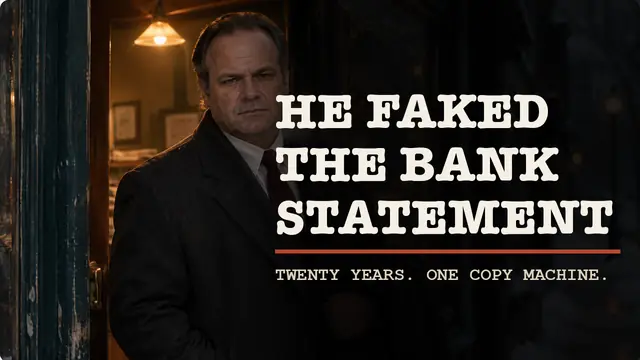
Peregrine Financial Group (PFGBest) of Cedar Falls, Iowa told regulators it held more than $200 million of customer money. For twenty years, its founder Russell Wasendorf Sr. forged the bank statements with a copy machine, and the regulators, the auditors and his own customers trusted the paper. A financial fraud documentary told from the court record: the CFTC, the NFA, U.S. Bank and the guilty plea.